Sous-Vide: Translated as “under vacuum,” this French term means that the food (usually meat or vegetables) has been cooked in an airtight plastic bag submerged in a temperature-controlled water bath for a very long time. Food prepared this way is always cooked evenly, with both the inside and outside equally tender.
Flash Frozen: With this molecular gastronomy technique, food is frozen almost immediately often by using liquid nitrogen. This allows the water inside fruits, vegetables and other fruits to freeze without creating large crystals or damaging the cell membranes, thus preserving the texture of frozen foods (which would otherwise be mushy when defrosted).
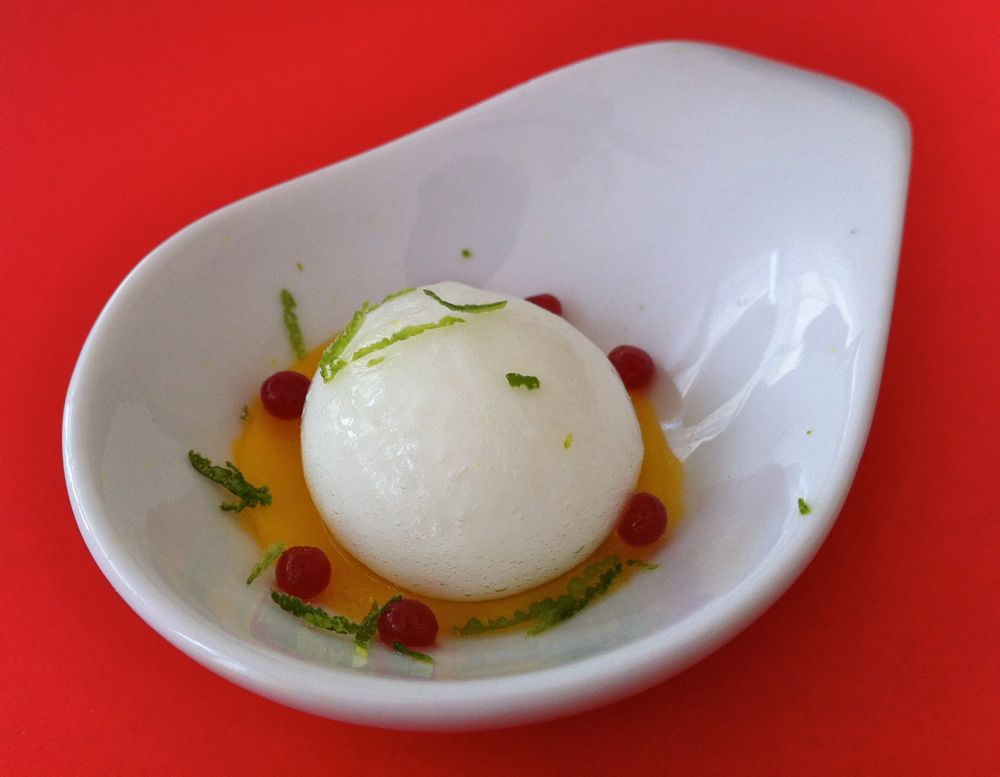
Faux Caviar: Using a process known as spherification, liquid food like olive oil, tea and fruit juice can be turned into tiny little balls that look like caviar. The liquid is held in its shape by a thin gel membrane and enjoyed as a solid.
Deconstructed: If you deconstruct a sand castle, you knock it down. This same idea applies to deconstructed dishes, which feature separate building blocks instead of having everything combined. Deconstructed dishes allow the diner to construct a customized experience in his or her mouth.
Edible Paper: Made with potato starch and soybeans, these tasty sheets of paper are often printed with edible fruit inks from a laser printer.
Powdered Food: Chefs use maltodextrin, a starch-like substance, to turn a high-fat liquid like olive oil into a powder.
Foams: If you’ve ever had a meringue on top of a pie, you’ve eaten a foam. Chefs are now turning fruits, vegetables and cheese into foams using food stabilizers and thickening agents.
To get a chef all worked up? Just ask him for his thoughts on molecular gastronomy, the strange cooking style that uses highly scientific techniques and ingredients to make other-worldly, modern cuisine. It's perhaps more popular in Spain and Chicago (and onTop Chef) than it is in NYC restaurants, but most culinary professionals in this city still have strong opinions about it, even if they don't cook that kind of food, or eat it often.
Many love the cuisine, but hate the name. Others think it's pretentious, overrated, or just "over" in general. But for whatever reason, chefs just love to talk about it. Here's a collection of soundbites from 15 top toques about molecular gastronomy.
1) Wylie Dufresne: "What does it even mean? What does it mean when you say to your wife, 'Hey we're going out to dinner tonight. Do you want Chinese, Italian or molecular gastronomy?'" [~EN~]
2) Thomas Keller: "Well, remember, molecular gastronomy is something the media has used as a phrase to identify a new style of food. It’s not something any of the cooks that are doing it have ever said about the food they do." [Gilded Fork]
3) Chris Santos: "A lot of times people ask me about new trends in cooking, like molecular gastronomy, and I say, ‘Just give me some fire and I’ll give you some good food.'" [Zagat]
4) David Chang: "It's never going to lose the name molecular. Hippies don't like being called hippies, but that's what everyone knows them by." [Time]
5) Michael Laiskonis: "While I embrace the spirit of what some term 'molecular gastronomy' and respect the serious practitioners of that style, I worry about the next generation of cooks coming up that might attach themselves too closely to it out of fashion, while ignoring the more basic fundamentals of cooking." [RG]
6) Johnny Iuzzini (on being called a "Molecular Gastronomist"): "That is such a horrible term, just because you have a modern style and use some modern techniques does not mean that you are a molecular gastronomist! That term doesn't sound delicious at all!" [Global Chefs]
7) Anthony Bourdain: "“It doesn’t sound like anything I would be in the mood for. The majority of people do it clumsily or badly. But when you complain about, you’re like my grandparents complaining about the electric guitar." [TSU]
8) Eric Ripert: "Molecular for molecular, cooking for the technique, I think that is over." [The Feast]
9) Daniel Boulud: "Molecular gastronomy is interesting for the mind, but not always interesting for the soul. It's very much like conceptual art. It triggers many senses, which are not known by yourself, but at the same time it doesn't leave you wanting to come back." [Vancouver Sun]
10) Jimmy Bradley: "It’s not for me to say, but you won’t see me messing around with it." [RG]
11) Dan Kluger: "I think there's certainly a place for molecular gastronomy and really high end cuisine. But for me, making great tasting food is why I'm here." [Star Chefs]
12) John Delucie: "Molecular gastronomy is lost on me. I don’t want to eat xantham gum and I am not captivated by a technology that’s gives us bacon ice cream. I prefer chocolate." [RG]
13) Alain Ducasse: "I prefer to be able to identify what I'm eating. I have to know. It's `wow' effect food, virtual food. If we were surrounded by these restaurants, we would be in trouble." [Bloomberg]
14) Joel Robuchon: "Too many chefs are attracted to molecular gastronomy... It’s not the kind of cuisine that should be important, with all the additives. I know I was really the first one to make it famous, but I have complete control of what I’m doing." [NYP]
15) Eddie Huang: "Me and @No7restaurant love molecular gastronomy but only if it involves astronaut ice cream." [Twitter]
New dishes named after famous scientists includes:
Gibbs - infusing vanilla pods in egg white with sugar, adding olive oil and then microwave cooking. Named after physicist Josiah Willard Gibbs (1839–1903).
Vauquelin - using orange juice or cranberry juice with added sugar when whipping eggs to increase the viscosity and to stabilize the foam, and then microwave cooking. Named after Nicolas Vauquelin (1763–1829), one of Lavoisier's teachers.
Baumé - soaking a whole egg for a month in alcohol to create a coagulated egg. Named after the French chemist Antoine Baumé (1728–1804).
This, H. Molecular Gastronomy a Scientific Look At Cooking. (n.d). Retrieved from https://www.agroparistech.fr/IMG/pdf/Molecular_Gastronomy_revise_texte_seul.pdf
Vartiainen, J.,Aksela, M. & Hopia, A. (2013). Introduction to molecular gastronomy and to its applications in science education. Retrieved from www.luma.fi/file_download/179
Snitkjær, P. (November 2010). Investigations of meat stock from a Molecular Gastronomy perspective. Retrieved from http://curis.ku.dk/ws/files/32448394/PHD.0111.pdf
Ivanovic, S., Mikinac, K. & Perman, L. (2011). MOLECULAR GASTRONOMY IN FUNCTION OF SCIENTIFIC IMPLEMENTATION IN PRACTICE. Retrieved from http://utmsjoe.mk/files/Vol.2%20No.2/0-2-2-3-Ivanovic-Mikinac-Perman-_Molekularna_gastr.pdf
Organic authority. (n.d). Retrieved from http://www.organicauthority.com/foodie-buzz/molecular-gastronomy-techniques-explained.html
Out for a long lunch. (n.d). Retrieved from http://outforalonglunch.com/tag/chinese-molecular-gastronomy
Have your cake and eat it too. (n.d). Retrieved from http://fatboyrecipes.blogspot.com/2009/04/molecular-gastronomic-dinner-by-chef.html
Wah, L, C. (2008). The Science of deliciousness. Retrieved from http://www.thestar.com.my/story/?file=%2F2008%2F1%2F27%2Flifeliving%2F20139204
Molecular gastronomy is a scientific discipline. (n.d). Retrieved from http://www.flavourjournal.com/content/2/1/1
Building food, molecule by molecule. (2014). Retrieved from http://www.prospectmagazine.co.uk/features/herve-this-the-worlds-weirdest-chef
Y, G, S. & Struwe, K. (n.d). Deconstructing Molecular Gastronomy. Retrieved from https://kitchen-theory.com/wp-content/uploads/2011/10/Deconstructing-Molecular-Gastronomy.pdf
Food for tomorrow. (n.d) Retrieved from http://www.ncbi.nlm.nih.gov/pmc/articles/PMC1679779/
Molecular economy, the food of the future? (2009). Retrieved from http://inside.capitaland.com/gourmet/156-molecular-gastronomy-food-of-the-future
Modern Cooking & the Erice Workshops on Molecular & Physical Gastronomy. (n.d). Retrieved from http://curiouscook.typepad.com/site/erice.html
‘Father of molecular gastronomy’ explores solution to world hunger. (n.d). Retrieved from http://www.bostonglobe.com/lifestyle/food-dining/2014/11/11/this-not-whole-egg-that-not-bacon/WN3mEBTcvBKpD1278Uj3DM/story.html
Harris, W. (n.d). How molecular gastronomy works. Retrieved from http://science.howstuffworks.com/innovation/edible-innovations/molecular-gastronomy.htm
Molecular gastronomy: Science behind the art of cooking. (2011). Retrieved from http://www.sciencedaily.com/releases/2011/07/110706122618.htm
From Chemistry Labs to the Kitchen: Molecular Gastronomy. (n.d). Retrieved from http://illumin.usc.edu/147/from-chemistry-labs-to-the-kitchen-molecular-gastronomy/
Molecular Gastronomy: A New Emerging Scientific Discipline. (2010). Retrieved from http://www.ncbi.nlm.nih.gov/pmc/articles/PMC2855180/ Warwicker, M. (2014). Kitchen science: What 'molecular cuisine' has taught us. Retrieved from http://www.bbc.co.uk/food/0/27243852
Chef blows off hands dabbling in 'molecular gastronomy'.(2009). Retrieved from http://www.thelocal.de/20090713/20575
Morabito, G. (2011). 15 New York Chefs That Don't Like 'Molecular Gastronomy. Retrieved from http://ny.eater.com/2011/3/7/6694029/15-new-york-chefs-that-dont-like-molecular-gastronomy
Molecular gastronomy is a new gourmet direction connecting the catering kitchen and laboratory, and thus creates new flavors, forms of unprecedented. It can be, of course, understood as a process of application of science in everyday cooking. Methods and means for obtaining the final products in the molecular gastronomy request the knowledge of the chemical and physical processes.
Of course, the introduction of molecular gastronomy requests, too, and some modifications in the approach to guests, number of courses of which every dish is extremely small - the art on a plate, losing the concept of menus and menu, while the duration of a meal takes several times longer. Certainly, this approach also affects the habits of the people towards healthy eating, where it is no longer considered to be a meal consumed in a shorter time, but the opposite, and making sure the food is consumed, and thus affects the reduction of today's problems related to overweight-obese population.
Modern molecular gastronomy shows the tendency toward further progress and popularization, but a noticeable impact on the so-called ''Molecular mixology'', and molecular approach to the preparation of cocktails, where just as in the case of food, it is changing the physical state of food and it is searching the limits of each food. The future is unpredictable, and in which direction to go to molecular gastronomy remains to be seen.
There are many elements which different restaurants and standard restaurants apply molecular gastronomy. Most would expect from such restaurants chefs in lab coats, and kitchen as a laboratory. But it is far from the truth, although there is a big and obvious difference between the standard and the restaurant of molecular gastronomy. In essence, they are more restaurants, and less laboratories.
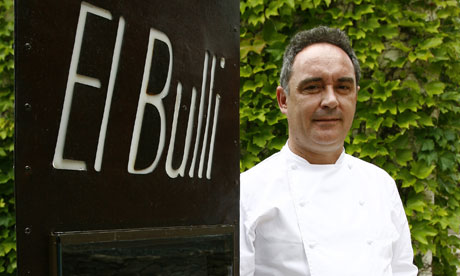
The differences are most evident in the approach and in the kitchen equipment as well as her appearance. The most famous restaurant, also the best restaurant in the world who is regarded as the main representative of the application of molecular gastronomy, El Bulli, chef Ferran Adrià.
CRITERION STANDARD RESTAURANT RESTAURANT MOLECULAR GASTRONOMY (El Bulli) Hierarchy and a strict hierarchy of specialization in one part of the cuisine (head chef, sous chef, sousier). No hierarchy. Size of food dishes medium size large to very large. Presentation of Standard 3-5 hours, sometimes more.
Those are the specifics that do not only characterize El Bulli, but also most restaurants of this type. The biggest difference is reflected in serving thirty small portions so called tasting menu. For this, there is a scientific reason because the brain after a while gets used to the taste, so it does not perceive what is consumed to such an extent after a long time, but the perception of taste becomes more automatic (although the taste is still present in the same way, the brain simply shuts down).
For this reason, there is this way of serving dishes. In addition, it should be that in most chef-scientists there is not only one flavor, but that they alter from the primary, secondary and tertiary, i.e. perception of a certrain meal takes place in several phases.
The word to cook is described as the use of heat to transform food for consumption.The
question is whether this is the only way to transform the food for consumption? Is the
heat the only that can be used to cook something? When the meat is removed from the
refrigerator it is dissolved, for this process the heat is also used, but for that meat we
would never say that it is cooked.
There are many ways for transforming foods in traditional gastronomy.With the development of
traditional ways of trying to introduce new and innovative ways.
From new ways of transformation of food used in mole are applied in the modern ''scientific'' molecular gastronomy. From new ways of transformation of food used in molecular gastronomy in
everyday practice can be applied:
Spherification in a bath of sodium alginate and water
An
innovative way of transforming food without the presence of heat. This is a technique
used for making, among other things, false and reverse olive caviar. There are many
variations of using this process, but the last two uses are the most often.
During
spherification the food is transformed in the way of placing them in a thin, slowly
solvable membrane of sodium alginate and calcium chloride. The process of
spherification in a big way introduces Spanish chef Ferran Adrià and he was one of
his trademarks.
For complete spherification it is required special equipment, and it consists of the
following components:
– sodium-alginate
– salt, calcium chloride (calcium without food can not be spherificated)
– spoons of different shapes and sizes
– syringe without a needle (for the fake caviar)
– water bath for stopping the process
Use of liquid nitrogen
Is a new technique in gastronomy. The
temperature of liquid nitrogen is -196°C and as such has long been used mainly for
various industrial purposes. Its use as a cooking technique reduces the production of
ice cream and sorbet. It is a great plus in making ice cream with liquid nitrogen so
that the crystals are very small due to the short time of freezing and thus ice cream
made in this way has a very creamy and smooth texture.
The concept at first, totally impossible to understand, but cooking with liquid nitrogen
is nothing more than cooking in a very cold medium. Because of the large so-called ''wow
effect'' the use of liquid nitrogen can be considered scientific, and especially since it is not
used in traditional cuisines, but it is more innovative way for the creation of an extremely
traditional preparations like ice cream or sorbet, which previously could only work
because most of the cooler was not able to achieve much lower temperatures and is no
more scientific to the bread making (McGee 2004).
Spherification in molecular gastronomy using sodium alginate in water